
Plants
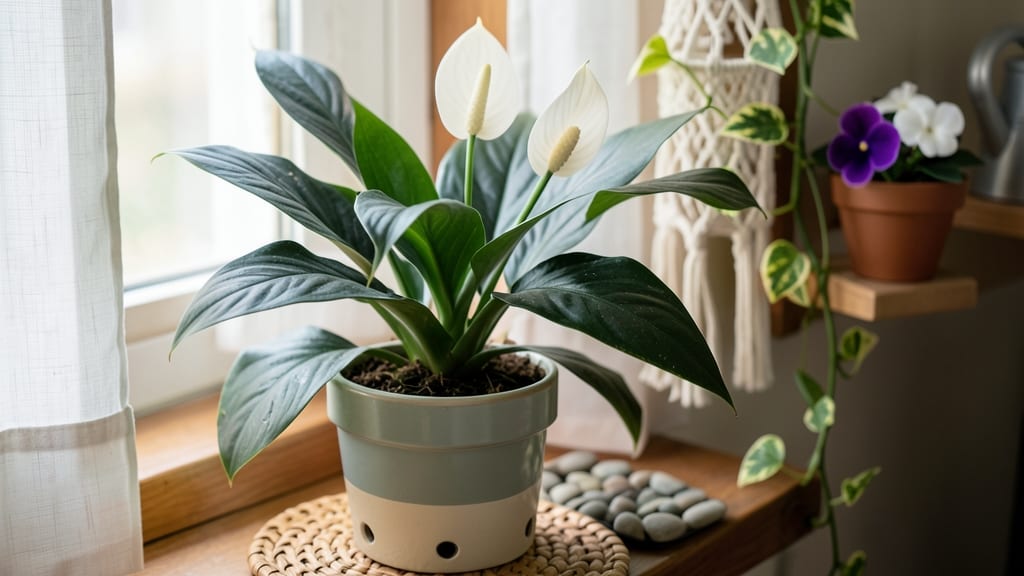
The best flowering plants to grow indoors thrive in low light and produce long-lasting blooms, including peace lilies, African violets, and orchids, which require minimal sunlight and consistent care for vibrant flowers year-round.
The secret to their success lies in their ability to adapt to indoor environments. 🌿 Unlike many flowering plants that demand bright sunlight, these varieties have evolved with broad leaves that maximize light absorption and efficient root systems to draw nutrients from limited soil.
Peace lilies, for example, can even thrive under fluorescent lighting, making them perfect for offices or sunless corners.
African violets store energy in their leaves, allowing them to bloom continuously when given the right care, while orchids develop specialized roots that absorb moisture from the air—ideal for maintaining humidity without overwatering.
What truly sets these plants apart is their resilience. Many can tolerate occasional neglect while still producing vibrant blooms, unlike fussy tropicals that need precise conditions.
The key is understanding each plant's specific needs—like orchids requiring a misting routine or African violets needing well-draining soil—to keep them flowering for months rather than weeks. This makes them ideal for beginners and busy plant parents alike.
💡 In This Article
- Why These Indoor Flowering Plants Excel in Low Light
- Care Tips for Long-Lasting Indoor Blooms
Why these indoor flowering plants excel in low light
These indoor flowering plants have evolved remarkable adaptations that let them thrive where most flowering species would struggle. Their broad, waxy leaves—like those of peace lilies—contain specialized cells called chloroplasts that are packed more densely near the leaf surface.
This allows them to capture even indirect light efficiently, converting it into energy through photosynthesis. In fact, peace lilies can produce flowers with as little as 200-500 foot-candles of light, compared to outdoor annuals that often need 1,000-2,000 foot-candles.
Their root systems play a crucial role too. Plants like African violets develop fine, fibrous roots that spread widely in the soil, maximizing nutrient absorption.
Orchids, on the other hand, have specialized velamen roots that store water and air, allowing them to survive in environments with fluctuating moisture levels—a common challenge in indoor settings. This root structure lets them absorb humidity from the air, reducing their dependency on frequent watering while still maintaining vigor. 💫
Another key adaptation is their ability to store energy. African violets, for example, accumulate starch in their leaves during periods of adequate light, which they later convert into blooms even when light conditions dip.
This energy reserve explains why they can produce continuous flowers for 6-8 weeks with proper care, unlike many outdoor plants that bloom in short seasonal bursts. The trade-off? These plants grow more slowly than sun-loving varieties, but their steady, predictable flowering makes them far more reliable indoors.
Light quality matters just as much as quantity. While outdoor plants rely on full-spectrum sunlight, indoor varieties adapt to the blue and red wavelengths emitted by fluorescent or LED bulbs.
Peace lilies, in particular, respond well to cool white LED lights (around 4,000-5,000 Kelvin), which mimic the natural light spectrum better than older incandescent bulbs. This adaptability is why they often outperform other flowering plants in offices or bathrooms with limited natural light.
Comparing them to outdoor flowering species highlights their efficiency. A sunflower, for instance, requires 6-8 hours of direct sunlight daily to produce its iconic blooms, while an African violet will happily flower under 4-6 hours of indirect light.
The difference lies in their evolutionary history—indoor-adapted plants have spent generations optimizing for low-light conditions, whereas outdoor species prioritize rapid growth and reproduction in bright, competitive environments. 🌱
One fascinating exception is the Kalanchoe blossfeldiana, which actually blooms better with 12-14 hours of darkness per day—a phenomenon called photoperiodism. This means it can flower indoors even with minimal light exposure, as long as its night cycle isn't interrupted by artificial lighting.
Such adaptations demonstrate how these plants have fine-tuned their biological clocks to indoor rhythms, making them uniquely suited for home environments.