
Plants
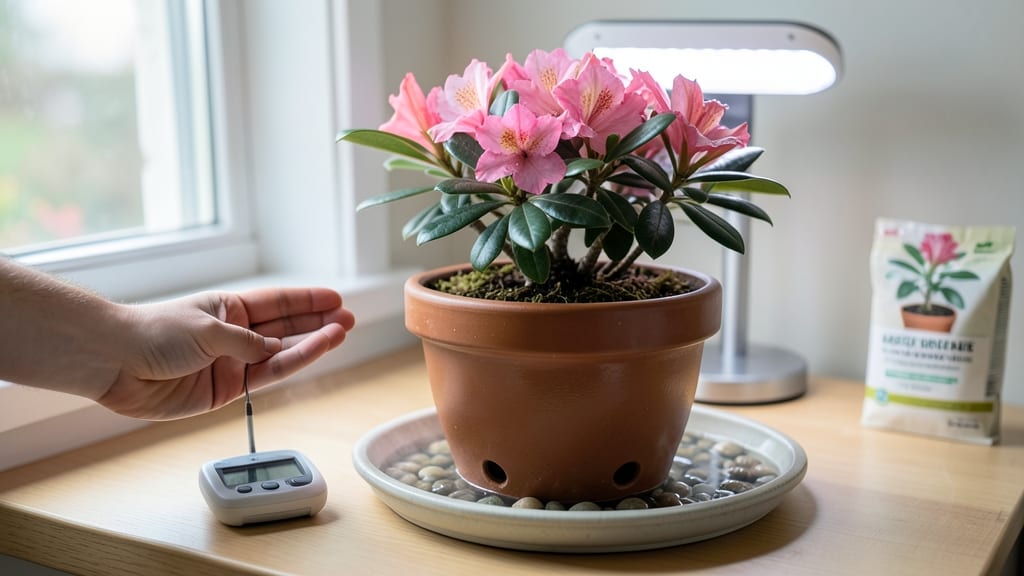
Azaleas can grow indoors with careful attention to light, humidity, and soil conditions, though they thrive best in outdoor environments where they receive natural sunlight and cooler temperatures. Choose dwarf varieties and place near east-facing windows for indirect light exposure.
Indoor azalea care requires balancing their natural preferences with home environments.
These plants need bright, indirect light for at least 6 hours daily—south or east-facing windows work best—but artificial grow lights can supplement during darker months. 🌿 The biggest challenge is humidity; indoor air often dries them out, causing brown leaf edges.
I've found using a pebble tray with water or a small humidifier near the plant helps mimic their preferred 40-50% humidity range. Container size matters too—small pots dry out faster, while oversized ones can suffocate roots.
For best results, opt for dwarf varieties like 'George L. Taber' or 'Dwarf Fuji Pink,' which handle indoor conditions better than larger types. These compact plants also recover faster from common indoor stressors like temperature swings near heating vents.
The key is patience—indoor azaleas grow slower than outdoor ones but reward you with stunning blooms when their needs are met.
💡 In This Article
- Indoor Azalea Light Requirements and Growth Challenges
- Best Indoor Azalea Varieties and Container Care Tips
Indoor azalea light requirements and growth challenges
Azaleas rely on photosynthesis efficiency that's finely tuned to natural sunlight, particularly the blue and red light spectrums (400-500nm and 600-700nm wavelengths) that drive chlorophyll production.
Indoors, most standard grow lights (like basic LED bulbs) emit only 10-30% of these critical wavelengthsleggy, weak stems and sparse foliage that many indoor azalea owners notice.
The solution lies in using full-spectrum LED grow lights (12-16 hours daily) that mimic natural daylight, particularly in winter when daylight hours drop below 10 hours. 💫
Temperature fluctuations indoors create another major challenge. Azaleas prefer 60-65°F daytime temps but can tolerate 50-55°F at night—a range many homes struggle to maintain consistently. Drafts from windows, heating vents, or air conditioning can trigger bud drop (where flowers fail to open) or leaf scorch.
I've seen this happen most dramatically when azaleas sit near south-facing windows during summer afternoons, where temperatures can spike to 80°F+ and create extreme heat stress. The fix? Place your azalea 3-4 feet back from windows and use a small fan to create gentle airflow without direct drafts.
Light intensity matters just as much as duration. Azaleas need moderate to bright indirect light—about 1,000-2,000 foot-candles (measured 12 inches from the plant). For comparison, a typical office receives 500 foot-candles, while direct sunlight can exceed 10,000 foot-candles.
Too much direct sun causes leaf burn (visible as crispy brown edges), while too little leads to pale, weak growth. East-facing windows provide the ideal balance, offering morning sunlight without the harsh afternoon rays.
If using grow lights, position them 6-12 inches above the plant and adjust as the plant grows.
One often-overlooked factor is the circadian rhythm disruption indoor lighting causes. Azaleas rely on natural light cycles to trigger blooming—typically needing 12-14 hours of daylight followed by darkness to set buds. Artificial lights left on 24 hours can prevent flowering entirely. The solution?
Use a timer for grow lights and ensure complete darkness during the plant's "night" period (usually 8-10 hours). I've had success with azaleas that receive natural light until 7 PM followed by grow lights for 2 hours to simulate sunset.
Seasonal adjustments are critical for indoor azaleas. During winter months, supplement with grow lights to maintain 12+ hours of light. In summer, move plants to shaded areas to prevent heat stress.
The root zone temperature (measured in the soil) should stay between 60-70°F—any hotter and root activity slows dramatically. A simple trick? Place the pot on a ceramic saucer (not metal) to help regulate soil temperature and prevent overheating from below.
Here's what happens when you get the light right: Azaleas develop dark green, glossy leaves with a thick, leathery texture (a sign of good health). The stems remain compact and sturdy, and buds form plentifully along the branches.
When light is insufficient, you'll notice yellowing between leaf veins (chlorosis) and new growth that's pale and sparse. The good news?
With proper light management, even indoor azaleas can produce vibrant blooms that last 2-4 weeks—a far cry from the struggling specimens many people assume are doomed indoors. ✨