
Container Gardens
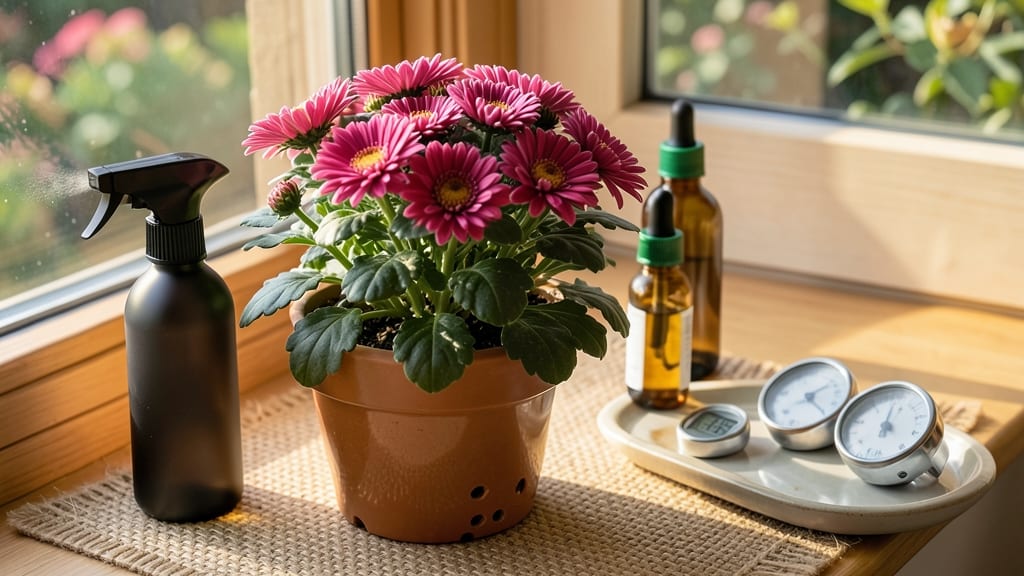
Mums (chrysanthemums) do not do well indoors because they demand intense sunlight and seasonal dormancy cycles that most homes can't replicate. While they'll survive with bright indirect light and cool conditions, blooming is nearly impossible without outdoor exposure.
Indoor lighting is the biggest hurdle—mums need 6-8 hours of direct sunlight daily, and even south-facing windows often provide only a fraction of that. 💫 The lack of natural light triggers dormancy instead of growth, and artificial grow lights can't fully compensate without proper spectrum settings.
Even when you provide ideal conditions, these plants prioritize survival over flowering, which is why you'll rarely see blooms indoors.
That said, with the right setup, you can keep mums alive indoors for years. Place them near the brightest window possible, supplement with a full-spectrum LED grow light for 12-14 hours daily, and maintain temperatures between 60-65°F during winter dormancy.
Water only when the top inch of soil feels dry, and use a balanced fertilizer in spring to encourage minimal growth—but don't expect vibrant blooms unless you eventually move them outside.
💡 In This Article
- Why Indoor Light Fails Mums’ Growth Needs
- Indoor Mum Care Hacks for Minimal Survival
Why indoor light fails mums’ growth needs
Mums (chrysanthemums) are sun-worshippers by nature, evolved to thrive under 6-8 hours of direct sunlight daily—a light intensity most indoor spaces simply can’t replicate. Their leaves contain high levels of chlorophyll that require intense light for efficient photosynthesis, particularly during their active growing season (spring to fall).
Without sufficient light, the plant’s energy production plummets, forcing it into a survival mode called dormancy—a state where growth slows dramatically to conserve resources. 💫
The problem isn’t just about brightness—it’s about light spectrum and duration. Natural sunlight provides a full spectrum of wavelengths, including critical red and blue light that trigger flowering (a process called photoperiodism).
Indoor fluorescent lights often lack these essential wavelengths, while even high-quality LED grow lights can’t perfectly mimic the sun’s output without careful calibration.
Most household bulbs emit too much green light (which plants reflect rather than absorb) and too little red/blue, leaving mums starved for the signals they need to bloom.
Temperature plays a sneaky supporting role in this light failure. Mums need cooler temperatures (60-65°F) during dormancy, but indoor heating systems often push rooms to 70°F or higher, confusing the plant’s internal clock. Warmer indoor air also increases humidity fluctuations, stressing the plant further.
The combination of weak light and inconsistent temperatures sends mixed signals to the plant’s phytochrome pigments—the molecular switches that regulate growth and flowering. Without the right cues, mums simply won’t invest energy in blooming.
Here’s the science: Mums are short-day plants, meaning they need 12-14 hours of darkness daily to trigger flowering. Most indoor environments don’t provide this consistency—artificial lights often run late into the evening, disrupting the natural photoperiod.
Even if you place your mum in the brightest window, the lack of full-spectrum light means the plant can’t complete photosynthesis efficiently, leading to stunted growth and weak stems. 🌱
Consider this comparison: A south-facing window might provide 2,000-3,000 foot-candles of light on a sunny day, while a mum needs 5,000-10,000 foot-candles to thrive. Most indoor grow lights max out at 3,000-5,000 foot-candles—still not enough to fully satisfy a mum’s light hunger.
This is why even well-intentioned indoor mum keepers often end up with leggy, sparse plants that never bloom.
The bottom line? Indoor conditions create a perfect storm against mum survival: insufficient light spectrum, inconsistent photoperiod, and temperature fluctuations all work against the plant’s biological needs.
Without outdoor exposure, blooming becomes nearly impossible, and even basic growth requires heroic efforts with supplemental lighting and careful environmental control. 🌿