
Plants
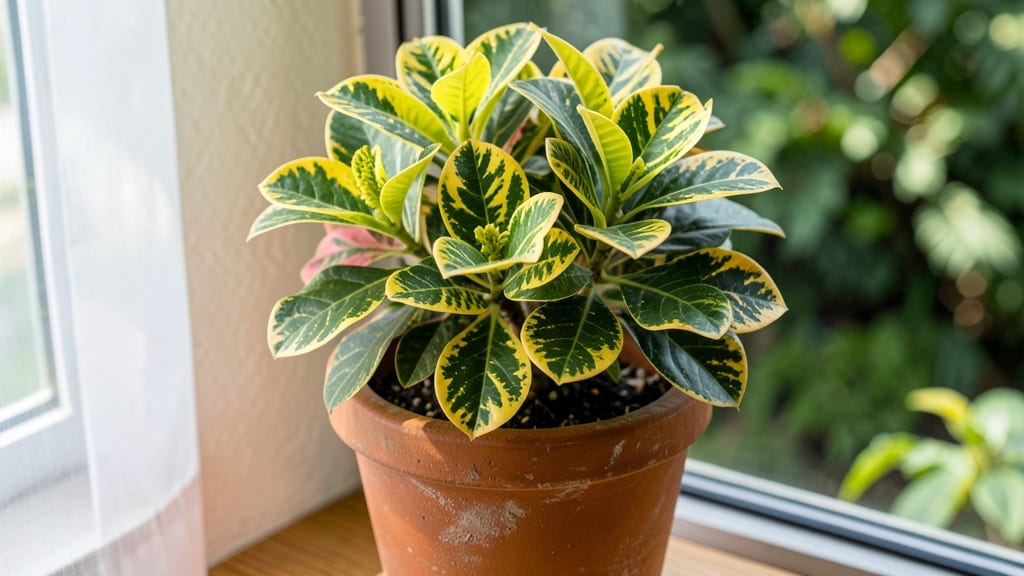
Deciding between indoor or outdoor placement for your Croton Gold Dust plant depends on light exposure, humidity control, and environmental protection—indoor plants need bright, indirect light and consistent misting, while outdoor plants thrive in partial shade with natural windbreaks to prevent leaf damage.
The Croton Gold Dust plant's vibrant foliage responds dramatically to its environment.
Indoors, you'll need to replicate its natural tropical habitat with bright, filtered light—think east or north-facing windows—and maintain 40-50% humidity through misting or a pebble tray. 💫 Outdoor plants, on the other hand, handle slightly more moisture naturally but require afternoon shade to avoid sunburn. The key difference?
Indoor plants demand more hands-on care, while outdoor varieties are hardier once established in sheltered spots.
For both settings, the soil mix matters just as much as light exposure. Indoor plants prefer well-draining potting soil with perlite, while outdoor plants benefit from amended garden soil with compost.
The Gold Dust variety's colorful leaves are particularly sensitive to temperature swings—keep indoor temps between 65-80°F and avoid placing them near drafts or heat vents. Outdoors, a sheltered patio or balcony with afternoon shade becomes their ideal sanctuary.
💡 In This Article
- Light and Temperature Needs for Croton Gold Dust Growth
- Watering and Soil Strategies for Indoor vs Outdoor Croton Care
Light and temperature needs for Croton Gold Dust growth
The Croton Gold Dust plant's stunning variegated leaves are a direct result of its light requirements. Indoors, this tropical beauty needs bright, indirect light—think of it as the equivalent of a dappled forest canopy.
Placing it within 3-6 feet of an east or north-facing window provides the perfect balance, delivering 10,000-15,000 lux of light intensity without the risk of leaf scorch.
Direct midday sun (especially south-facing windows) can cause those gorgeous gold patterns to fade or develop brown patches, as the chlorophyll breaks down under 25,000+ lux conditions.
Temperature plays a crucial role in maintaining that vibrant foliage. Indoor Gold Dust plants prefer a consistent range of 65-80°F—any lower than 60°F and you'll notice leaf drop as the plant conserves energy, while temperatures above 85°F can cause wilting.
The key is avoiding temperature swings of more than 10°F in 24 hours, which can stress the plant.
Outdoors, this variety handles slightly wider temperature ranges (down to 55°F and up to 90°F) but requires protection from cold drafts and sudden heat spikes that can occur in coastal climates.
Humidity becomes the critical differentiator between indoor and outdoor success. The Gold Dust croton's native tropical habitat thrives at 40-60% humidity, which is challenging to maintain indoors during winter when heating systems drop levels to 20-30%.
This is why you'll see leaf edges crisping or curling—it's the plant's response to dry air. Outdoors, natural humidity from morning dew and afternoon breezes often provides ideal conditions, but urban environments can still fall short.
The solution? For indoor plants, a daily misting routine or placing the pot on a pebble tray with water creates a microclimate that mimics its natural environment.
What most growers don't realize is how light quality affects those gold patterns. The yellow variegation comes from a genetic mutation that reduces chlorophyll production in certain leaf areas. When exposed to blue spectrum light (400-500nm wavelength), these yellow regions actually photosynthesize less efficiently than the green areas.
This is why you'll see the gold patterns become more pronounced in lower light conditions—the plant "chooses" to prioritize the green chlorophyll-rich areas for energy production. For maximum vibrancy, supplement with a full-spectrum LED grow light (5000-6500K color temperature) for 12-14 hours daily during winter months.
The outdoor environment presents different challenges. While natural sunlight provides ample intensity, the angle and duration vary by season. In summer, when the sun follows a higher arc, you'll need to provide afternoon shade after 2 PM to prevent leaf scorch.
The telltale sign of too much sun is when the gold variegation develops white or yellow patches—this is called "sun bleaching" where the pigments degrade under intense UV exposure.
For container plants moved outdoors, always use a lightweight shade cloth (30-50% block) to filter direct rays while allowing beneficial diffuse light to reach the leaves.
Seasonal transitions require special attention. When moving Gold Dust plants outdoors in spring, acclimate them gradually over 7-10 days by increasing their outdoor exposure by 1-2 hours daily. This prevents "transplant shock" where sudden light intensity changes cause leaf drop.
Conversely, when bringing them indoors for winter, place them in their final position immediately to avoid stress from light fluctuations. The plant's natural photoperiod (light cycle) is 12-14 hours of light, so supplementing with grow lights during short winter days prevents the variegation from fading.