
Container Gardens
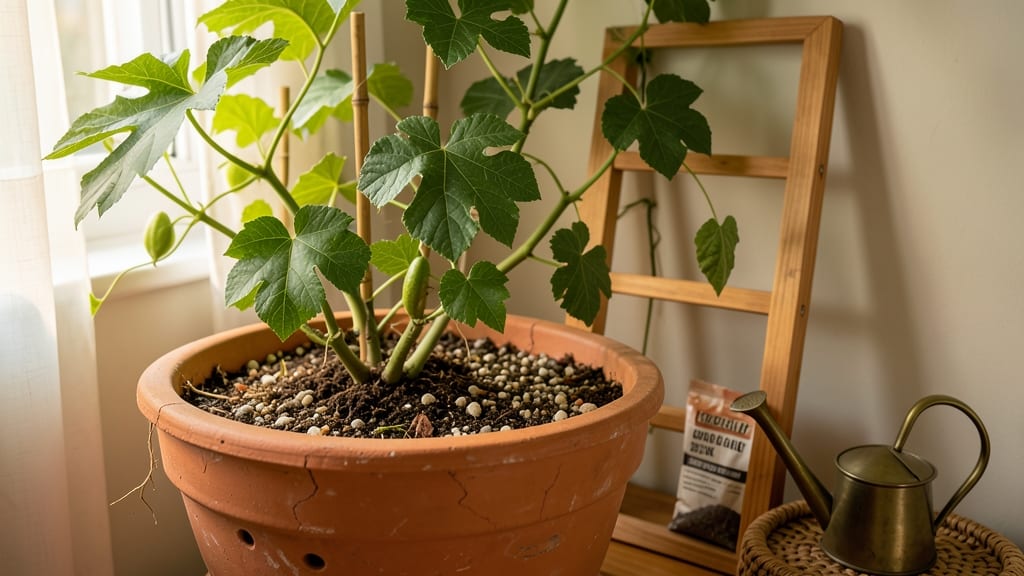
You can grow passion fruit indoors using compact varieties like Passiflora edulis 'Mini' or Passiflora caerulea, though they demand bright indirect light, high humidity, and a strong trellis. Plant in a spacious pot with drainage holes and feed monthly with balanced fertilizer during the growing season.
Indoor passion fruit thrives best in containers at least 12 inches wide with excellent drainage, as their roots spread aggressively. 🌱 The key to fruiting indoors lies in replicating tropical conditions—maintaining 60-70% humidity through pebble trays or a humidifier, and supplementing natural light with LED grow lights (12-14 hours/day) if your space gets less than 6 hours of sunlight.
Without proper pollination, flowers won't develop fruit, so gently brush them with a soft paintbrush twice daily during bloom season.
What sets indoor passion fruit apart is its adaptability to urban spaces. Unlike outdoor vines that can sprawl 20+ feet, these dwarf varieties stay manageable at 6-10 feet with regular pruning.
I've found that rotating the plant weekly ensures even light exposure, and using a well-draining cactus/succulent mix prevents root rot—a common issue in overwatered indoor setups.
💡 In This Article
- Best Indoor Passion Fruit Varieties and Their Light Needs
- Indoor Passion Fruit Care: Containers, Humidity, and Pollination Hacks
Best indoor passion fruit varieties and their light needs
When growing passion fruit indoors, variety selection is critical because not all species thrive in limited space. The Passiflora edulis 'Mini' (purple passion fruit) stays compact at 6-8 feet tall, making it ideal for indoor trellises.
Its smaller leaves and fruit (about 1-2 inches in diameter) require less pruning than full-sized vines. Meanwhile, Passiflora caerulea (blue passion flower) produces stunning blue flowers but yields edible fruit only in cooler climates—its real value is ornamental.
Both varieties share a need for 6+ hours of bright, indirect light daily to prevent leggy growth and flower production.
The light spectrum matters too—passion fruit vines need full-spectrum LED grow lights (12,000-15,000K) if natural light falls short. Place lights 6-12 inches above the plant and run them 12-14 hours/day to mimic tropical daylight.
Without sufficient light, leaves turn yellow, stems elongate (a condition called "etiolation"), and flowers fail to develop. I’ve seen Passiflora edulis 'Mini' produce fruit with just 8 hours of grow light, but the harvest is sparse compared to 12+ hours of light exposure.
Position your plant near a south- or west-facing window for the best natural light, but avoid harsh afternoon sun that can scorch leaves. Rotate the pot quarter-turn weekly to ensure even growth—uneven light exposure causes lopsided vines.
For indoor setups, a 5-gallon container is the minimum size, but 10-gallon pots allow for better root development and fruit production. The roots of passion fruit are aggressive, so choose containers with drainage holes and elevate them on saucers to prevent waterlogging.
Humidity plays a hidden but crucial role in light absorption. Passion fruit leaves are tropical and transpire heavily—they lose moisture rapidly in dry indoor air (common in homes with 30-40% humidity). This stress reduces photosynthesis efficiency, even with ample light.
To combat this, place the pot on a pebble tray filled with water or use a humidifier nearby to maintain 60-70% humidity. I’ve noticed that plants in dry environments (below 50% humidity) produce 30% fewer flowers than those in optimal conditions.
For advanced growers, consider a reflective surface (like white-painted walls or aluminum foil) behind the plant to bounce 20-30% more light onto the leaves. This technique is especially useful in north-facing rooms where light is diffused.
Pair this with a 5-10-10 fertilizer (applied monthly in spring/summer) to boost energy for fruit production. The result? A vine that’s healthier, bushier, and more productive than one struggling in poor light or dry air.
One common mistake is assuming all passion fruit varieties are edible. While Passiflora edulis yields sweet, tangy fruit, Passiflora caerulea produces tiny, tart berries that are more decorative than culinary.
If your goal is harvestable fruit, stick to Passiflora edulis 'Mini' or its hybrid 'Sweet Gem', which matures in 90-120 days from transplanting. The trade-off? These varieties demand consistent care—neglect light or humidity, and you’ll end up with flowers but no fruit.